


MANUFATURING
 Electrical steel
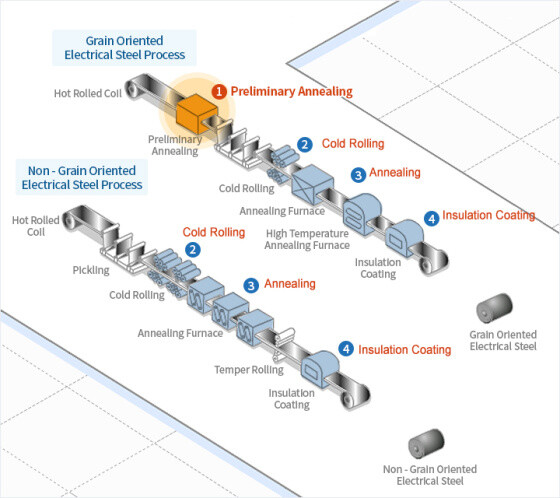
1. Preliminary Annealing: During the preliminary annealing process, a scale which may have formed on the hot rolled steel is removed as delayed passing through scale breaker and a hydrochloric acid bath. This initial heat treatment process improves the cold rolling properties of steel as well as its magnetic properties.
2. Cold Rolling: In order to obtain specific thickness and material properties, a reduction ratio of 40-90% is applied normally. Rolling and edge trimming machines are automatically controlled to obtain uniform thickness and width.
3. Annealing: Annealing is a process in which cold rolled structures are converted to a recrystallized structure through heat treatment. For grain oriented electrical steel, two different annealing methods are available: decarbonization annealing and high-temperature annealing. Decarbonization annealing removes excess carbon from the steel and applies a MgO coating. High-temperature annealing produces secondary recrystallized structures having superior magnetic properties.
4. Insulation Coating: In this process, insulation coating is applied by a continuous coater roll in order to minimize eddy current losses, which are proportional to the sheet thickness. A series of coaters are used to apply insulation coating liquid to the top and bottom of a plate. Grain oriented electrical steel has two layers of coating, a base coating of dark brown Forsterite (Mg2SiO4) as the main ingredient and a transparent insulating coating containing phosphates. For non-oriented electrical steel, various coating methods with various thicknesses and ingredients are used depending on end usage and specific user’s requirements.More Content Cold Rolled Steel
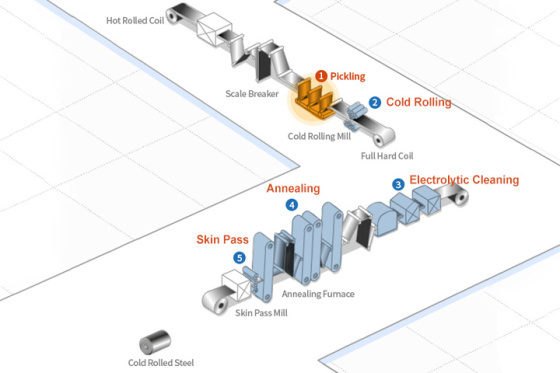
1. Pickling: Hot rolled coils pass through a pickling line, where scale breaker machines and hydrochloric acid solutions are used to remove any surface scale and/or oxide film that which causes surface flaws during the final stage of cold rolled steel processing.
2. Cold Rolling: Pickled coils are cold rolled in tandem mills to a specified thickness, typically 40 to 90%, of original material dimensions. Fully automated shape adjustment is ensured through state of the art process machinery.
3. Electrolytic Cleaning: The purpose of electrolytic cleaning is to remove lubricant oil and contaminants on the cold rolled steel prior to the annealing process.
4. Annealing: This is a highly productive manufacturing method whereby steel products with extra deep drawing qualities and high tensile strength can be produced. Two annealing methods are commonly used: batch annealing and continuous annealing.
5. Skin Pass: This final rolling process is performed in order to remove minor surface defects such as stretch marks and to produce a smooth, lustrous surface. Skin Pass results in a further thickness reduction of about 1%.More Content

Related Posts
Online Message
Please give us a message